
Projects
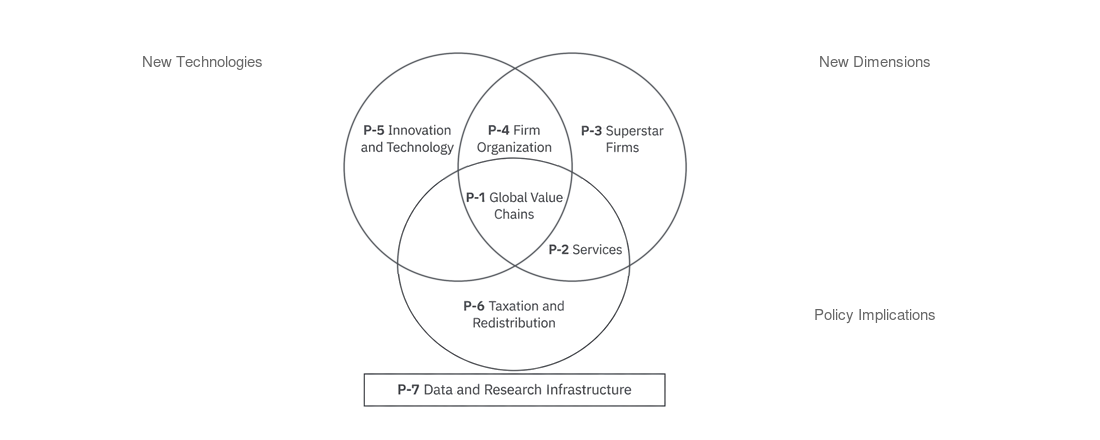
By linking theoretical, empirical, and quantitative approaches across seven fields, the projects generate a comprehensive account of contemporary changes in the "International Division of Labor" and the implications for firms, workers, and public policy. The seven projects are divided into six "Research" and one "Data and Research Infrastructure" project.
- Project 1: Global Value Chains Hide
-
The emergence of Global Value Chains ("GVCs") and their implications for the international division of labor have taken an important role in the international trade literature and the policy debate. The “Global Value Chains” project contributes to this research by exploring the interaction of GVCs and trade policy. Thereby, we study new challenges for trade policy due to the emergence of GVCs as well as the impact of trade policy on the structure of these chains. Both of these aspects have surfaced the public debate in the wake of the COVID-19 pandemic and the resulting disruptions in sequential production processes as well as in the recent tariff escalation under the Trump administration in the United States, provoking policy makers to reassess the resilience of global value chains to supply-side and policy-induced shocks.Coordinators Hosting Institutions Prof. Dr. Hartmut Egger University of Bayreuth Prof. Dr. Lisandra Flach ifo Institute Prof. Dr. Udo Kreickemeier University of Göttingen - Project 2: ServicesHide
-
In the “Services” project, we examine the role of services in Global Value Chains, explore the challenges and synergies arising from the joint export of goods and services, and investigate how the production of services differs from that of manufactured goods. We also analyze how the need for service inputs - such as financial services -influences foreign investment decisions and the performance of multinational firms.Coordinators Hosting Institutions Prof. Dr. Carsten Eckel LMU Munich Prof. Dr. Florian Unger University of Göttingen - Project 3 : Superstar FirmsHide
-
In the "Superstar Firms" project, we examine how globalization alters the market power of these firms in both goods and factor markets. With regard to factor markets, our focus lies on labor and capital markets, where we will investigate distortions caused by the presence of large superstar firms - either through monopsony power or other market imperfections that restrict their access to essential production inputs. We also explore internal aspects of global superstar firms, addressing the important question of what makes them particularly attractive employers beyond the wage premiums they typically offer. Finally, we investigate how challenges arising from non-integrated factor markets influence the entry-mode decisions of superstar firms in foreign markets.Coordinators Hosting Institutions Prof. Dr. Carsten Eckel LMU Munich Prof. Dr. Florian Unger University of Göttingen - Project 4: Firm OrganizationHide
-
The “Firm Organization” project focuses on addressing the challenges posed by new dimensions of trade and increasing uncertainty in global markets on the organization of firm-level production processes. Thereby, we put emphasis on the role of firm organization for the transmission of international shocks. More specifically, we zoom in on shock transmission within multi-product firms and the differences in shock transmission between exporters and multinationals. Additionally, we explore how firms should optimally adjust to an increase in perceived risk and uncertainty. In this context, particular emphasis is placed on the restructuring of product lines in multi-product firms and changes in the mode of foreign market entry. This project contributes new theoretical insights into shock transmissions within firms, alongside empirical and quantitative analyses of the significance of the identified theoretical mechanisms.Coordinators Hosting Institutions Prof. Dr. Carsten Eckel LMU Munich Prof. Dr. Hartmut Egger University of Bayreuth Prof. Dr. Lisandra Flach ifo Institute - Project 5: Innovation and TechnologyHide
-
In the “Innovation and Technology” project, we explore the interplay between trade and innovation in open economies. We focus on the crucial role that managers in global firms play in decisions regarding market entry and technology adoption, often treated as distinct aspects of profit maximization in existing research. Additionally, we examine the relationship between offshoring and technology adoption, analyzing when they act as complements or substitutes in a firm's production process decisions. Furthermore, the project illuminates the distributional effects of trade by analyzing how foreign market entry and technology adoption interact to determine the distribution of economic rents across firms. In this context, we aim to provide a comprehensive perspective, highlighting the relative importance of labor reallocation within and between industries as well as the reallocation of labor across firms and occupations for overall income distribution.Coordinators Hosting Institutions Prof. Dr. Hartmut Egger University of Bayreuth Prof. Dr. Udo Kreickemeier University of Göttingen - Project 6: Taxation and RedistributionHide
-
In the “Taxation and Redistribution” project, we analyze linkages that exist in the presence of firm-level heterogeneity between personal income taxes and corporate taxes on the one hand and globalization on the other. Thereby, we start from the premise that globalization typically leads to aggregate gains, but also to more inequality and adverse labor market effects for some individuals. The welfare state can redistribute the gains from trade through a tax-transfer system. However, in models of firm heterogeneity, the preferred redistribution scheme will likely influence the entry decision of firms at home and in their export markets, thereby interfering with market efficiency. Within this project, we analyze combinations of different tax instruments and will particularly highlight interactions in tax-free allowances, determining the tax base, and marginal income tax rates regarding their impact on the equity-efficiency trade-off in government decisions.Coordinators Hosting Institutions Prof. Dr. Udo Kreickemeier University of Göttingen Prof. Dr. Florian Unger University of Göttingen - Project 7: Data and Research InfrastructureHide
-
Empirical work in the six projects outlined above directly benefits from the “Data and Research Infrastructure” project, which collects new data on trade barriers, hosts all other datasets used in the research unit, and provides administrative support in data management. We create the most comprehensive tariff database on tariff barriers by combining most-favoured nation (MFN) and preferential tariffs with other types of tariffs. We also extend efforts from the literature to create new tariff data that accounts for preference utilization rates and a database on product-level non-tariff barriers. We aim to develop a novel database and generate insights, new research ideas, and applications to be concluded. Beyond the collection of new data, the data and research infrastructure project also provides a common framework for data management and support that will increase synergies and connect the activities of all individual projects.Coordinator Hosting Institution Prof. Dr. Lisandra Flach ifo Institute